
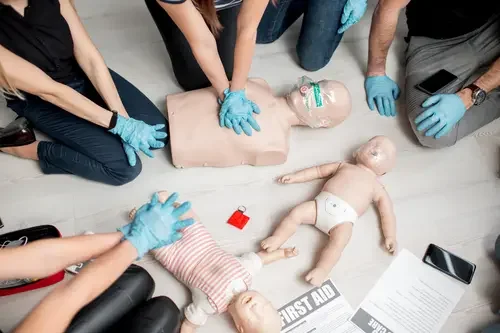

Course Set - Provide First Aid in an education and care setting (HLTAID012), Asthma (22702VIC) & Anaphylaxis (22578VIC)
This course set is designed to provide individuals with the knowledge and skills to provide a first aid response to infants, children and adults. The course applies to educators and support staff working within an education and care setting where persons may be required to respond to a first aid emergency, including asthmatic and anaphylactic emergencies.
We offer training across Victoria, including the Mornington Peninsula, Horsham, Mildura, and Wagga Wagga, making it convenient for you to access high-quality instruction near you.
-
The following units will be included in your certificate:
HLTAID009 - Provide cardiopulmonary resuscitation
HLTAID010 - Provide basic emergency life support
HLTAID011 - Provide First Aid
HLTAID012 - Provide First Aid in an education and care setting
22578VIC - Course in First Aid Management of Anaphylaxis
22702VIC - Course in the Management of Asthma Risks and Emergencies
-
Course durations can vary for multiple reasons, so the durations below are the minimum possible amount.
Face-to-Face face-to-face contact time of at least 9 Hours 30 Mins
Online with face-to-face assessment face-to-face contact time of at least 1 Hour 30 Mins
-
An individual undertaking this course with Allens Training Pty Ltd will need to demonstrate the following to be eligible for entry:
An official form of photo identification (e.g., driver’s licence, passport, or student ID).
Physical capability to be able to meet the demands of the practical demonstration skills including CPR.*
As a minimum, entrants to the course must have literacy and numeracy competencies equivalent to the Australian Core Skills Framework Level 3. An example of an ACSF Level 3 competency is being able to read and comprehend the ASCIA Action Plan for Anaphylaxis, use and respond to communication techniques to request appropriate emergency assistance at the scene of a First Aid incident and use writing skills to complete incident reports.
To successfully complete this course, students will need to demonstrate the following language, literacy, numeracy and digital (LLND) skills during training and assessment:
Learning: Follow clear steps, ask for help when needed, and learn from feedback to improve.
Reading: Read and understand short texts like health instructions, signs, and emergency or care procedures.
Writing: Fill out forms or write short, clear notes about an incident or emergency situation.
Oral communication: Speak clearly, listen carefully, and give or receive information in a health or care situation.
Numeracy: Use simple numbers to measure time, understand labels, or calculate basic amounts when needed.
Digital Literacy: Use a mobile phone or basic device to read messages, follow online instructions, complete online forms or access learning resources
*Important note: In order to issue an accredited certificate, CPR must be performed on the floor with no exemptions.
Online learning: Students must have basic digital literacy skills to navigate online platforms, complete assessments, and access course materials. Before enrolment, students should assess their ability to engage in online learning. Support is available where required. The online learning program can be found in the student portal. Students must have access to a computer, smart phone, tablet or other electronic device with access to the internet to complete the online studies and associated assessment tasks.
Delivery mode: Online with face-to-face: The online pre-course learning and theory assessment is expected to take approximately 7 hours to complete. These timeframes are estimates. Individuals with prior experience in similar training may complete the online component in less time, while those new to the subject may need more time to complete all the learning content and theory questions.
-
he units have the following recommended renewal periods:
HLTAID009 - Provide cardiopulmonary resuscitation 12 months
HLTAID010 - Provide basic emergency life support 36 months
HLTAID011 - Provide First Aid 36 months
HLTAID012 - Provide First Aid in an education and care setting 36 months
22578VIC - Course in First Aid Management of Anaphylaxis 36 months
22702VIC - Course in the Management of Asthma Risks and Emergencies 36 months
-
Please note that enrolment to this course is made with Allens Training Pty Ltd RTO 90909. Please refer to the student handbook located on the RTO website allenstraining.com.au (https://allenstraining.com.au/students/student-handbook) for all details relating to rights and responsibilities including complaints and appeals.
-
Practical demonstrations:
Provide adult CPR (incl. the use of an AED)
Perform CPR on a child
Provide infant CPR
Manage a choking child and infant casualty
Manage a child casualty with non-life-threatening bleeding and shock, requiring minor wound cleaning
Manage a child casualty with a nosebleed
Manage a child casualty with a fracture and dislocation
Manage a child casualty with a sprain and strain
Manage a child casualty with envenomation (snake/ funnel-web spider bite)
Infant - Administer asthma medication using a mask and spacer
Child - Administer asthma medication (with a spacer) using a Personal Asthma Action Plan
Adult - Administer asthma medication (without a spacer), using the Asthma First Aid Protocol developed by NACA
Administer an adrenaline autoinjector for anaphylaxis
Provide first aid for an allergic reaction
Case studies:
Case Study 1: Risk Assessment & Emergency Management Strategy (for an individual with asthma-like signs and symptoms, with no previous diagnosis)
Case Study 2: Risk Assessment & Emergency Management Strategy (for asthma episodes for an individual diagnosed with asthma)
Documentation:
Complete a First aid/Incident report form
Complete a Risk Assessment form
Complete an Individual Management Plan, which includes a Communication Plan
Theory assessment:
A written exam consisting of multiple choice questions
-
Students are required to complete a self evaluation against the following core skills as part of the enrolment process. This will allow your trainer to understand any additional support that may be required during the course delivery and assessment.
Learning - I can follow clear steps, ask for help when needed, and learn from feedback to improve what I do.
Reading - I can read and understand short texts like health instructions, signs, and emergency or care procedures.
Writing - I can fill out forms or write short, clear notes about an incident or emergency situation.
Oral Communication - I can speak clearly, listen carefully, and give or receive information in a health or care situation.
Numeracy - I can use simple numbers to measure time, understand labels, or calculate basic amounts when needed.
Why Train with Us?
-

Convenient Locations
Courses available in Mornington Peninsula, Horsham, Mildura, and Wagga Wagga.
-

Expert Trainers
Learn from healthcare professionals with extensive real-world experience.
-

Fast Certification
Receive your nationally recognized certificate promptly upon completion.
-

Fast Turnaround
Receive your certificate promptly after completion.
